News · Control
64TH ARIEL AWARDS: 'El exorcismo de Carmen Farías.' A Frightful Presence
CRÓNICA
 It is the horror film that most captivated the Academy. COURTESY By ULISES CASTAÑEDA AND AJ NAVARRO The 19th installment in our series of features leading up to the 64th edition of the Ariel Awards ceremony turns to this year’s most striking Mexican horror film: El exorcismo de Carmen Farías. FOR THE GOLDEN AGE OF MEXICAN CINEMA
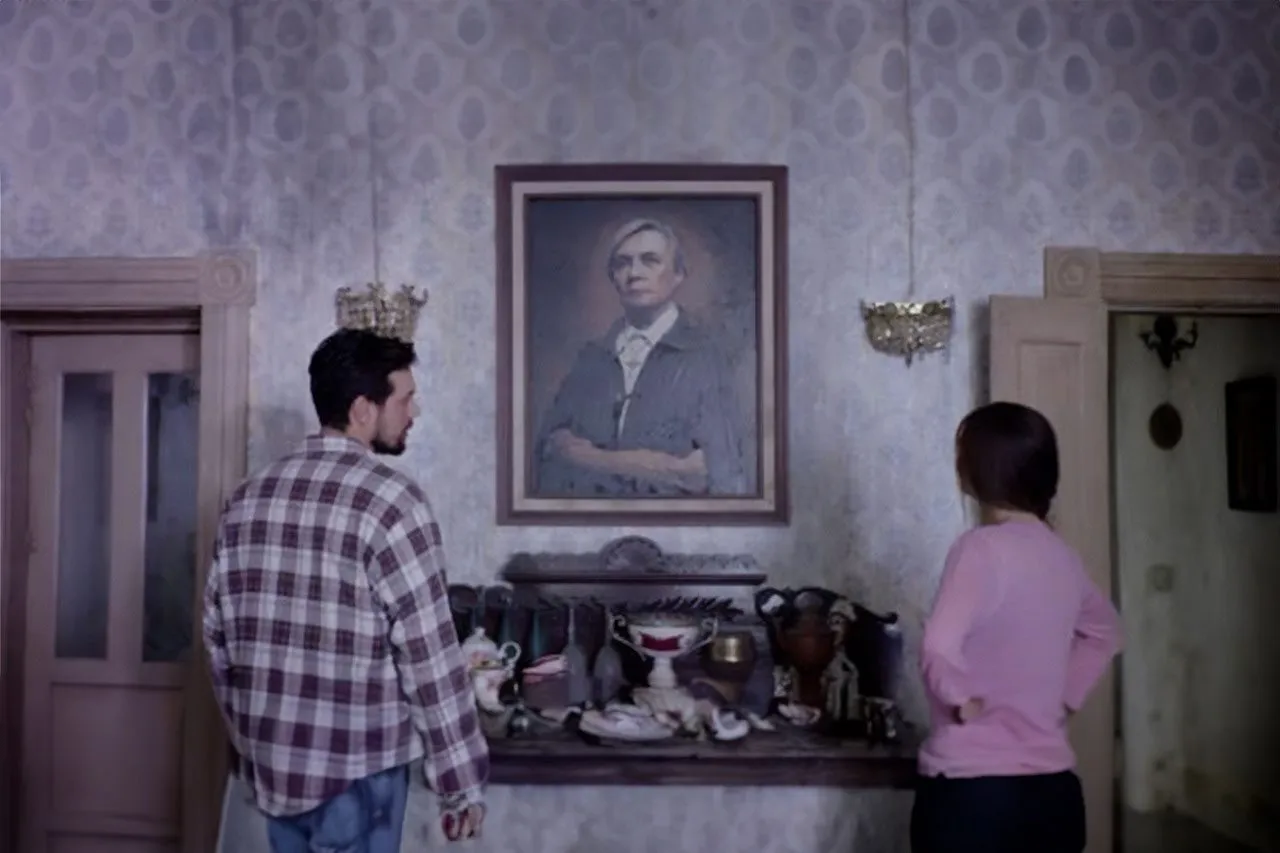
Director Rodrigo Faillega ventures into the horror genre after his debut feature, Ricochet, to tell a story in which Carmen (Camila Sodi) discovers that she has inherited her grandmother’s house. There, she finds that the place hides secrets about her grandmother, and that she must now finish the battle against the demon her grandmother began in order to save her.
That is the premise of El exorcismo de Carmen Farías, a fresh attempt within Mexican cinema to revive the golden age of horror once crafted by Carlos Enrique Taboada. On Crónica Escenario we had the chance to chat with its stars, Juan Pablo Castañeda and Camila Sodi, about the making of this project. “First of all, I was drawn by the privilege of being able to work, which as an actor in this career can often be very difficult. Then came the pleasure of working with Camila and everyone involved in the project. I am very grateful to them and had a great time doing it,” Castañeda begins, adding that he had other motivations for taking part in the film. “The chance to make a horror film, which is so important in order to explore the genre and bring it back into the spotlight, excited me. I think we are very happy with the result,” he adds.
The production was shot in the town of El Oro, located in the State of Mexico, and the shoot took six weeks. This is the first horror film either Sodi or Castañeda has been part of, and both hope it marks the beginning of greater diversity in Mexican cinema.
It stars Camila Sodi, Juan Carlos Colombo and Juan Pablo Castañeda, under the direction of Rodrigo Fiallega and from an original screenplay by Molo Alcocer. A FILM MADE BY HORROR FANS Camila Sodi stressed that the first thing that drew her to this tale of exorcisms was the screenplay. “I loved it from the first time I read it. I found it very interesting how the lead character was built, someone who would be alone 70 percent of the time, and how the house became another character. I also liked the subject, because it is so rooted in small-town life. When I was little I traveled to many small towns with my family, we loved the idea, and there wasn’t a single place where someone didn’t tell us about a supernatural event that had happened. Making a film that had everything we Mexicans love about legends, myths and stories, all of that, was very appealing,” she said. They also talked a bit about their relationship with such a popular genre as horror and shared some of their tastes. “I like it, no doubt. I think I liked the older films more. Now I enjoy them, but they scare me more, I don’t know why. It is supposed to be the other way around, but that is what happens to me these days,” Sodi recounted. “As a child you have more curiosity, you are more open to many things and you really want to be scared. As we grow up, we start keeping our distance from it. And without a doubt, my favorites in the genre are those 1980s Hollywood films, from Freddy Krueger to It,” Juan Pablo continued. The film’s screenwriter is Molo Alcocer Délano, a graduate of the American Film Institute Conservatory, where he wrote and produced the horror short Reaver, which was selected for competition at Fantastic Fest, Screamfest and A Night of Horror Film Festival, where it won the award for best Lovecraft short film. With this experience and other projects to his credit, the screenwriter gives this exorcism film a distinctly Mexican touch.  With this film, Camila Sodi returned to the big screen. COURTESY
“Molo, who is from Querétaro, told us that there are many stories about exorcisms there that have touched him very closely. But he also said that there is a school for exorcists, for priests who are taught to perform this ritual in the year 2021. I think it is very interesting to talk about the things that happen in our country and that people truly live through,” Camila says.
“That is intense, and I don’t think I had thought about it until now that you mention it. We are seeing all of this reality through a film, but now imagine that it really does happen, and that perhaps as we speak right now someone is being exorcised. With that information, watching the film, I think it carries even more emotion,” Juan Pablo revealed in turn. Meanwhile, the actor Pablo Castañeda said that one of the most striking things was realizing that, in real life, exorcisms are common in some communities across the country. “Today there is a school of exorcism in Querétaro; it is fascinating that this subject exists and is so close to the surface. Besides, Mexico is a country built on religion, myths and legends (…) that is why Mexicans can connect with the genre. We live on mystery, and we are all passionate about knowing what lies beyond,” Castañeda noted. A FILM WITH ITS OWN LEGENDS As part of its launch, a video was posted on YouTube in which several people who worked on the production claimed that paranormal events occurred in the house where the story was shot. In the video, the screenwriter, Molo Alcocer, and the lead, Camila Sodi, can be seen affirming that the film was shot in a genuinely abandoned location, built more than 100 years ago in a remote town in the State of Mexico. As in any horror film, the curious anecdotes about scares were not to be missed during the shoot of El exorcismo…: “They did scare us, frankly. It sounds like a cliché, but it really happened. We filmed in a house from the 1800s where we heard children running, and twice the makeup assistant had her hair pulled,” Sodi said. “Doors would suddenly close, everything creaked. That house location, on its own, drew you in; it already transmitted a sense of fear, a sense of terror where we don’t know what happened there, and if the walls could talk, who knows what they would tell us,” Castañeda added with his own take. Meanwhile, one of the people in charge of the set design claimed that: “strangely, the dolls turn up every day with their heads turned around… They are not the way we left them the last day we set up the set.” Confirming that paranormal things did occur on the shooting set, Carolina Acosta, director of photography, voiced her fear as she recounted: “We went in and the crucifixes were placed up above the bed; it left me with a feeling stuck in the pit of my stomach.” For her part, Camila Sodi, at a press conference for the release, said that it was difficult to film when they were being frightened every day: “I’ll tell you, I don’t know if you believe in this or not, but in the house where we filmed, yes, there was definitely something strange there. The film crew would run out; you should have heard the screams they let out… you could hear children laughing. We were all being frightened and we filmed at night.” And, as in any horror film, the house where these events take place becomes another character. “We felt that sensation similar to Silent Hill, when there is a piece of architecture that speaks to you on its own. And that is exactly what happens in this film, because this place is genuinely another character,” Sodi affirms. SEEKING TO INSPIRE MORE MEXICAN STORIES The lead, Sodi, who returned to the big screen after her success in Luis Miguel, La serie and Rubí, lamented that Mexican audiences do not value the cinematic work made in the country, and asserted that the quality of current national cinema is very high. “We are very harsh on the Mexican product, and we are always trying to see where our colleague fails. I think we are at 2021 production levels. Just as we can go and compete in Berlin and win, we have a lucrative comedy industry, so why not start making genre films?” the actress told the international agency EFE. To wrap up the conversation with Crónica Escenario, Sodi offers an interesting reflection on what we see in Mexican horror cinema. “One thinks it is something of the past, or that it is an influence of other foreign films that carry the exorcism label, but no. It is something that happens in Mexico to this day. We have to be aware that this is a reality, no matter how crazy it may seem to us.” ARIEL NOMINATIONS: 2 Best Makeup: Mari Paz Robles Best Visual Effects: Roberto Ham *Read the original story